
Discover Rupadhatu – The Heart and Soul of Borobudur’s Spiritual Path

Borobudur Temple, the world’s biggest Buddhist monument, tucked within the beautiful hills of Magelang, Central Java, is much more than an architectural marvel. It is a living mandala in three dimensions representing the entire Buddhist cosmos and inviting every visitor on a deep spiritual trip. The temple is split vertically into three cosmic realms: Kamadhatu, the realm of desire, at the bottom; Rupadhatu, the realm of forms, in the middle; and Arupadhatu, the realm of formlessness, at the top. The heart of the temple is in Rupadhatu, commonly termed the “body of the temple.” This is the level where art, architecture and philosophy meet in the most striking way.
What Is Rupadhatu?
The word Rupadhatu (Rūpadhātu) comes from Sanskrit: “rupa” meaning form or physical shape, and “dhatu” meaning realm or element. In Mahayana Buddhist cosmology, Rupadhatu represents the transitional stage where beings have freed themselves from the crude desires of the material world (as symbolized in Kamadhatu) but are still bound by “forms” and “names”—physical appearances, concepts, and sensory experiences.
It is the bridge between attachment to the world and ultimate release. The three-realm model is the most popular interpretation of Borobudur by UNESCO, researchers and official guides, although recent academic studies (including a 2025 paper in the SPAFA Journal) imply Borobudur is more of a gradual “roadmap” to Buddhahood on the Bodhisattva path. Either way, for today’s travelers, it’s the most visually stunning and spiritually meaningful aspect of the temple.
Architectural Wonders of Rupadhatu
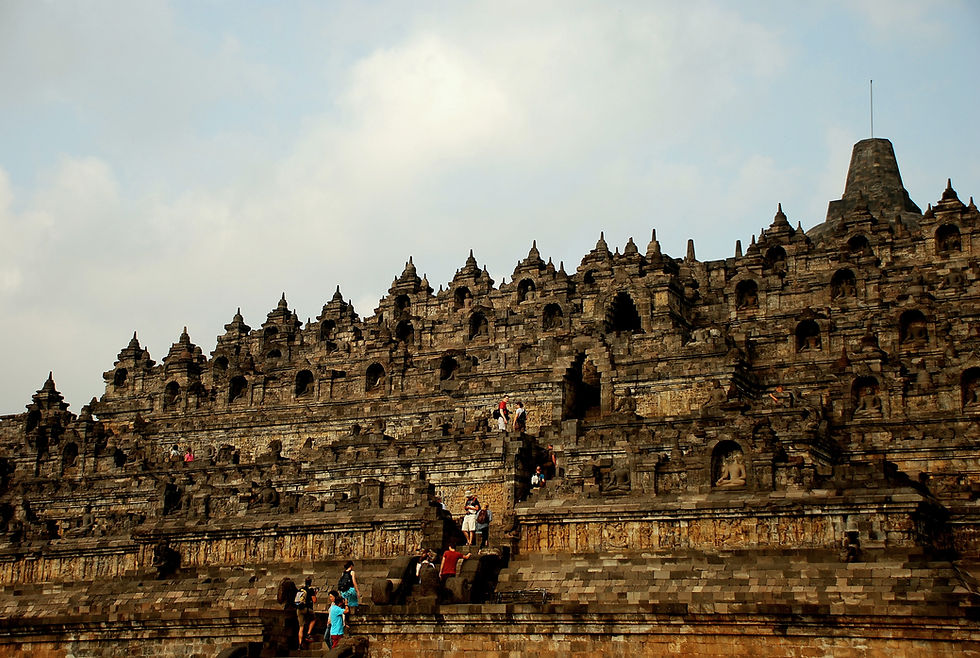
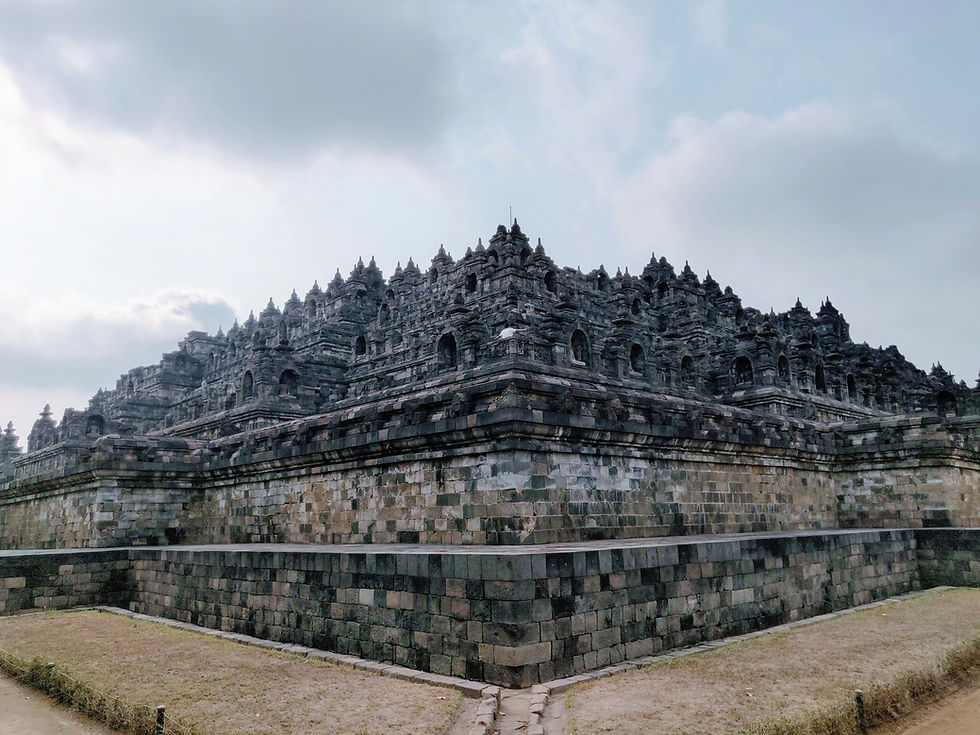
Rupadhatu consists of five square terraces that gradually step inward as they ascend, giving a stepped-pyramid look. Visitors go from level to level in the temple along four galleries with balustrades, where they can do the traditional clockwise circumambulation known as pradaksina. The square shape and ornate adornment (Kala-Makara gateways, carved niches and miniature stupas) contrast well with the plain circular platforms of Arupadhatu above, visually reflecting the transition from a world still "bound by form" to one of pure transcendence.
The architects of the Sailendra dynasty (8th-9th century CE) expertly harnessed this development as a reflection of the inner journey. The higher you go, the easier and more tranquil the space becomes.
The Epic Reliefs: A Stone Storybook
Rupadhatu is home to one of the world’s greatest “stone libraries." There are over 1,300 narrative relief panels and 1,212 ornamental panels, which cover nearly 2.5 kilometers of wall. They were visual textbooks for the ancient pilgrim and they still fascinate the visitor of today.
Key series include:
Lalitavistara (around 120 panels) – The complete life story of Prince Siddhartha Gautama, from his birth to his enlightenment under the Bodhi tree.
Jataka and Avadana – Hundreds of tales of the Buddha’s previous lives, teaching morality, sacrifice, and the law of karma.
Gandavyuha (around 460 panels) – The spiritual quest of young Sudhana, who meets 53 teachers on his path to ultimate wisdom.
Walking the galleries and “reading” the reliefs in sequence is like a moving meditation.
The 432 Buddha Statues of Rupadhatu
Lined with 432 seated Dhyani Buddha statues in separate niches, the outer balustrades. Their numbers decline from one terrace to the next (104 on levels 1 and 2, 88 on level 3, 72 on level 4, and 64 on level 5), representing the growing renunciation of earthly attachments. Each statue faces one of the cardinal directions and bears distinct mudra (hand gestures) depicting the five Dhyani Buddhas: Vairocana, Akshobhya, Ratnasambhava, Amitabha and Amoghasiddhi.
Why Rupadhatu Matters Today
For the modern traveler, Rupadhatu is where Borobudur comes alive. The dawn light plays on antique carvings, a gentle breeze comes through the galleries and there is a peaceful sense of stepping across time. Whether you are a history buff, a seeker of spirituality, or just a curious wanderer, this level provides the perfect mix of cultural depth and visual splendor.
Rupadhatu stands as a UNESCO World Heritage Site, meticulously preserved for future generations to experience its enchantment. Conservation initiatives protect the fragile reliefs from erosion, and sustainable tourist practices guarantee the monument is accessible and respected.
Rupadhatu is not another stop on a temple tour. It is the spiritual and creative soul of Borobudur. A walk through its galleries is a rare chance to experience millennia of wisdom in the midst of stunning art.
Ready to experience it for yourself? Join Kresna Tour for an unforgettable Borobudur sunrise tour, private guided visit, or multi-day cultural adventure. Our expert local guides will bring the stories of Rupadhatu to life, helping you truly understand and appreciate this sacred place.
Book your Borobudur tour today and let Rupadhatu be the highlight of your Indonesian journey. Discover more than stone and carvings—discover a timeless path to inner peace.
Comments